Navigating Digital Strategy
Gaurav Saluja connects the dots across business and technology

A quarter of the way into the 21st century, and it’s almost a cliché to say that every business is a digital business. But it’s true: According to a 2023 study, 93 per cent of organizations had already adopted, or had plans to adopt, a digital-first business model. How organizations choose to use technology, data and AI is now a central business imperative. This is the domain of the dedicated digital strategist—a relatively new, rapidly expanding and increasingly vital role.
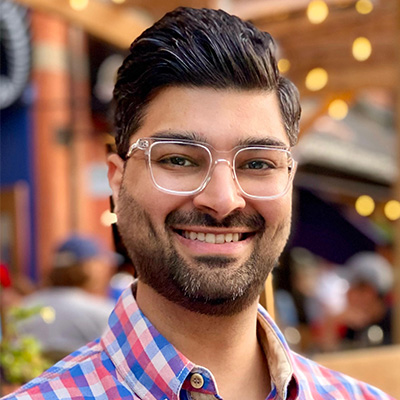
Gaurav Saluja (MBA'12)
Title: Digital Strategy and Transformation Leader, EY
With close to 20 years in tech-related roles, Gaurav Saluja has seen a lot of digital trends come and go—and watched a lot of organizations chase them without a plan—which has only galvanized his conviction about the power of a well-developed strategy.
"In this new world where machines are capable of doing so much, digital strategy will be absolutely critical," says Karen Jackson-Cox, executive director of the Smith Career Advancement Centre. “Organizations across every sector will need strong leadership in this space.”
Saluja works as a Digital Strategy and Transformation Leader at EY, where he consults with a diverse complement of clients to help them navigate this brave new world. “I think of digital strategy as a forward-looking view for organizations to achieve certain goals and/or outcomes through means of technology,” he explains.
What does it mean to work in digital strategy, and what does it take to build a career in this space? Saluja shares his thoughts.
How did you come to work in digital strategy?
When I was young I thought I’d be a doctor or a researcher in the medical field, so I did my undergrad in biochemistry and biotechnology. I had, and have, a lot of appreciation for that work, but I eventually realized it’s not something that I was very passionate about. What I was passionate about was technology: Ever since I was a kid opening up calculators to see how they worked, I was always into it.
At the very start, after I finished my undergrad, I was exploring different roles in different industries, just trying to understand ‘Where do I fit?’ This was nearly 20 years ago. The world of technology was moving at a pace that was unprecedented at the time, so I decided to try to build a career in that space. I started in technology sales, then moved into consulting. I built technical depth in multiple areas, sharpened my problem-solving abilities, and surrounded myself with mentors who pushed me to grow into different opportunities. That led to leadership roles, where I began guiding teams and shaping the direction for my clients. And that brings me to today: I encompass all those things, but what I really focus on is impact—not just for the companies I work with, but more broadly, for the industries, the communities and the people that are affected.
How do you explain your job to others?
If I have three seconds, I say that I solve problems through technology for a lot of organizations.
But if I have more time, I’ll say I help companies navigate complexity, enabling them to make smarter decisions, deliver better experiences and unlock new opportunities. I essentially act as this bridge between business and tech, helping clients figure out how to translate all the fast-moving digital innovation available today into real-world outcomes.
What are your key responsibilities?
There’s huge variety, and it’s different every day. I spend some days in boardrooms, helping organizations to prioritize their most complicated digital issues. Other days, I’m sitting with my teams, brainstorming the top three options that we want to present to a client from a list of 10. Some days, I shift between strategy, problem-solving, working with different personalities, and working at pace.
On any given day I’m working cross-functionally—inside my organization, my clients’ organizations, technology partners, and other broader ecosystem players. A lot of my role is getting the right teams together and helping them operate.
A typical workday is less about routine and more about purpose. My focus is always on strategy that doesn’t sit on paper, but shows up in results.

What about your job tends to surprise people?
That digital strategy really isn’t about technology. Technology is at the core of it, of course—it’s the enabler. But the real work is about putting multiple moving pieces together. It tends to surprise people when they understand the degree to which you need to build influence to navigate challenges and create trust.
Another misconception is that digital strategy just sits in boardrooms, with top executives. The truth is that the real impact comes from influencing and building trust, from frontline teams in the organization, to—sometimes—different companies in an industry, depending on the mandate.
It’s all a lot less about chasing the latest tool or technology than people think. It’s much more about creating a strategy that can be executed, absorbed, sustained and evolved in the future.
What do you love most about what you do?
The variety. Every day is different. Every challenge is different. No two days are alike, and I find that really energizing.
And, of course, I love it when the strategies we create show up in real results for companies—when you can see it affecting how people behave and how they operate. The work we do changes companies, and sometimes even industries, and that’s very fulfilling. That’s what gets me up every morning.
What skills are most valuable in your work?
You have to have the curiosity to learn, and to learn at pace. You have to be adaptable, comfortable navigating ambiguous environments, and able to solve very complex problems in a way that truly matters.
And you have to be able to work well with others. This is a team sport, involving a lot of different domains. It’s your job to act as a connector and a translator—to zoom in and zoom out at the same time—to help your clients get where they need to go. That can mean developing a level of fluency in different disciplines and learning how to translate what a person with one depth of knowledge has to say to a person with another depth. The people who have, nurture and build those interpersonal skills tend to do best and grow in this career.
What excites you about the future of your profession?
As technology is evolving at an unprecedented pace, digital strategy and transformation is becoming incredibly exciting. What excites me most is the opportunity to be at the intersection of technology and human potential. AI is not replacing us; it’s amplifying our ability to solve complex problems, make data-driven decisions and create meaningful impact. The future is about collaboration—between humans and machines, across industries and within organizations. It’s about building ecosystems where innovation thrives, and where strategy leads to tangible, positive outcomes for businesses and society alike. We can use technology to drive innovation and make things better for people. That’s what really excites me.
The degree and pace of change means that clients are demanding more from us than they did five years ago, and I expect that will continue. The business model for consulting firms will definitely change—in fact, it is already changing. But it’s actually quite exciting to be at the forefront of helping change the business model of your own organization while doing the same for your clients.
What’s your best advice for people considering a career in digital strategy?
Explore broadly in the early days of your career. Try different things out and build relationships with different types of people. Don’t lock yourself down into one narrow path too quickly. The richness of a good digital strategy comes from connecting different things together. I think going too narrow, too soon, could be a mistake—the more diverse your experiences, the more perspective you’ll bring to the table.