How Digital Product Managers Shape What’s Next
Kris Hayward loves watching an idea evolve into a deployed product that adds real value

In the past two decades, digital product management has evolved into a respected profession, with practitioners now helping to bring ideas to life on servers and screens for organizations of all shapes and sizes. It’s a role that requires both technical expertise and distinctly human strengths (including collaboration, communication and curiosity), qualities that make it especially relevant in today’s employment market.
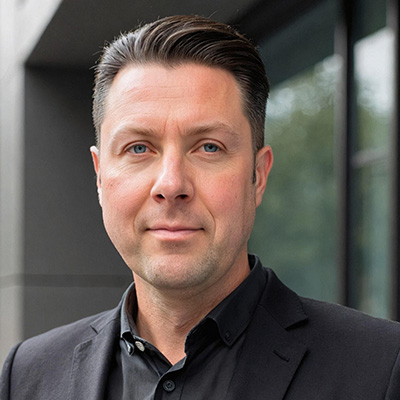
Kris Hayward (MDPM'23)
Title: Principal Digital Product Manager, Suncor
According to Karen Jackson-Cox, executive director of the Smith Career Advancement Centre, functions that combine softer skills with domain fluency aren’t going away. “In fact, that’s precisely what employers are looking for.”
Someone who knows all about balancing hard and soft skills is Kris Hayward. As Principal Digital Product Manager at Suncor, he oversees all digital consumer experiences that fall under the Petro-Canada banner, including the brand’s mobile apps and marketing technology platforms.
On paper, it’s a big job. In practice, it’s even bigger. His work allows him to leverage his education (including an undergrad degree in marketing and economics from the University of New Brunswick, and a Masters of Digital Product Management from Smith School of Business), his experience (including the better part of a decade in retail customer experience roles at Apple), and his enthusiasm (“I just love the process of bringing ideas to life”), as he works with dozens of stakeholders to deliver products that make a difference.
Here, Hayward explains what exactly a digital product manager does all day—and what others need to succeed in this fast-growing and ever-changing profession.
How did you come to work in digital product management?
I landed in retail management after my undergrad, and I grew into different roles doing that. I started to discover the technology track when I joined Apple in 2011. Apple is really great at offering you experiences within the organization, so I got to do things like travel the world and open some interesting stores all over the place. I learned how I could help in designing internal systems—by, for example, helping to design a new Genius Bar concierge system. That was my first exposure to product development and developing technology, and I grew doing that for years.
So when I was hired at Suncor in 2019, I brought with me a lot of technical background, but also a good awareness of how people use things. And when an internal position came up to be a digital product manager, I said, “You know, this sounds like all of the things I love to do coming together: retail, developing systems and doing the right thing for the customer.”
I formally became a digital product manager in 2021 and it’s grown from there. I now own all downstream Petro Canada apps that are at the market, as well as some other programs. I’ve found my fit.
How do you explain your job to others?
I consider myself the guardian of the user experience. It’s on me to uncover what that customer really needs—and to prioritize that feature for them based on the value that it’s going to bring back to them, as well as the business. My job is to keep everyone aligned on what we can develop that delivers impact all around.
I always think myself as a conductor of an orchestra. I don’t write the code, I don’t design the interfaces, and I don’t run the marketing campaigns. But I bring together the engineers, designers, data analysts and business stakeholders, and I make sure we’re all working together to build the right product for our user.
The role requires keeping a bird’s eye view on everything. Because of that, my knowledge needs to run about a foot deep and a mile wide.
What are your key responsibilities?
There’s no typical day for me. We’re always discovering new things and shifting priorities.
One of my key responsibilities—maybe the biggest one—is product strategy and roadmapping. That involves figuring out where we are and where we’re going with our current and future digital products. I might spend time in design reviews, or discovery research, or looking at metrics for our products to see where we might be going off the rails. I might spend a few hours reviewing business cases, or in ideation workshops to uncover pain points that could be opportunities, or sitting with stakeholders on the marketing or strategy or governance teams to provide the digital perspective on what we can accomplish together.
Probably the biggest part of my job is people management. I have a team of nine right now, mostly product owners, but also UX designers. It’s my responsibility to support them in their careers.

What about your job tends to surprise people?
It’s less about having all the answers and more about orchestration and collaboration under uncertainty. Some people think that we spend our day brainstorming cool features or developing flashy things to launch. That’s part of it, for sure. But it often shocks people how much time we spend walking the tightrope between technology constraints and business objectives, as we work to meet that real user need. We’re constantly assessing trade-offs. We might identify a quick win in one area, but it might mean pushing back on the scope of another. Or we might have an internal request to add more features, but a user who wants simplicity. It takes a lot of careful thought to navigate.
What do you love most about what you do?
I love watching an idea evolve from a sketch on a wall—we have actual whiteboards in our hallway—into a deployed product that adds real value to the people using it. There’s nothing quite like that process. It’s incredibly satisfying.
What skills are most valuable in your work?
Empathy is a big one. I think it’s at the heart of digital product management. You could build something that is creative and looks amazing, but if you’re not thinking about how it will impact people, it’ll never be worth very much. You need to deeply understand and advocate for your users’ needs, pains and aspirations. And you need to understand why very different business stakeholders—with very different needs—want to do what they are asking for. If you can’t take an empathetic approach to what your customers and your internal stakeholders need, this career may not be for you.
Curiosity is also really important. It really helps to be the kind of person who relentlessly asks, “why?” and “what for?” The first questions I'll ask whenever I’m in a room are, “Why do we want to do this?” and “What’s it going to do for our users?” That’s what allow you to deliver what makes sense.
Communication skills also matter a lot. You may have amazing data to support a feature you want to develop, but that’s only one piece. You have to be able to tell a great story about what will happen as a result of the development in order to build out the business case and gain stakeholder buy-in.
Finally, you need to get comfortable dealing with very different stakeholders. Context-switching is a big part of the job. You have to be able to step into one room and talk technical architecture and then step into another room and talk about business implications. If you can get that down, this kind of job could be a really great fit.
What excites you most about the future of your profession?
I really get energized about the pace of change in our field. Think of how technology, platforms and user behaviour changes: There’s always something new emerging. Right now, that’s things like AI, edge computing, immersive experiences, data-driven personalization. Tomorrow it might be different. If you love technology, like I do, this job allows you to be right at the forefront of what’s next. You get to look at everything that’s possible and ask, “How do we leverage all this to the best of our ability?”
What’s your best advice for people considering a career in digital product management?
Think about the type of business you want to work in. Digital product management exists in a lot of businesses, not just tech companies. This field is growing like crazy. If you look on LinkedIn or on any job site, you’ll see companies of all types hiring digital product managers. It’s everywhere.
If you love retail, like I do, look for a role at a retailer. Or if you love money, look to work in finance. It’s really important to figure out what lights you up because, in my experience, when you’re passionate about the product you’re developing, you’ll be far more likely to be satisfied in your work.