Curriculum
Smith's MMAI curriculum is delivered through a combination of lectures, seminars, experiential learning, team assignments, projects, presentations, real-world problem solving and a capstone project.
Core Courses
Introduces the core concepts of AI and machine learning, including supervised and unsupervised learning, deep learning and neural network architectures, and large language models, covering how they are trained, adapted, and applied in business contexts. Provides the working foundation for understanding how AI systems are built, what they can and cannot do, and where their limitations and failure modes lie. Equips students to interpret model behavior, ask the right technical questions, and engage credibly with engineering and data science teams.
Develops practical capability in applying generative and agentic AI across business functions. Covers prompt engineering, retrieval-augmented generation, and the design of GenAI-enabled workflows, with emphasis on producing, refining, and critically improving AI-generated work. Examines how AI agent reasons and acts in dynamic environments, focusing on the design, supervision, and governance of agentic workflows, including task decomposition, tool use, multi-agent orchestration, escalation protocols, and the management of autonomous behavior in organizational settings. Introduces systematic evaluation of GenAI and agentic systems, developing the judgment to determine whether their outputs meet the standard required for real work. Addresses the practical economics of working with models, including inference and API costs and the trade-offs involved in model selection.
Examines how organizations structure complex decisions and how AI is transforming decision-making itself. Builds on optimization, simulation, scenario modeling, and decision analysis as foundations for reasoning under uncertainty, with emphasis on recognizing the assumptions and trade-offs embedded in prescriptive models. Extends these foundations to AI-enabled decision processes, including framing problems so that AI systems can act on them, designing decision workflows with feedback loops that improve over time, and determining which decisions to automate, which to augment, and where human judgment must remain. Examines how AI reshapes the economics underlying business decisions, from cost structures to pricing power and investment logic, and what this implies for how decisions should be framed and who should make them.
Explores the end-to-end lifecycle of AI products, from problem discovery and use-case scoping through design, iterative delivery, and scaling. Covers user needs analysis and design thinking, product vision and roadmapping, agile delivery and MVP development, and the planning required to move products from pilot into production. Students apply rapid prototyping with low-code and no-code AI tools to test assumptions, validate value, and communicate with technical and non-technical stakeholders. Equips graduates to lead AI product teams and translate between user needs, business goals, and technical constraints.
Examines the ethical, technical, legal, and governance dimensions of deploying AI responsibly. On the technical side, covers model fairness, explainability, robustness, privacy-preserving methods, and AI-related security risks. On the governance side, covers ethical frameworks, the evolving regulatory and policy landscape, risk assessment and mitigation, governance structure design, and audit readiness. Develops the operational practices that make responsible AI real, including guardrails, systematic evaluation and quality assurance, benchmark-setting, and the monitoring of operational risk. Equips graduates to design and run the organizational structures that keep AI systems trustworthy, compliant, and accountable.
Examines how AI reshapes work, roles, and organizational structures, and develops the capability to architect the organizational response. Covers displacement and augmentation effects across job, frameworks for assessing workforce impact, and the talent planning implications of AI-driven change. Central to the course is the design of human-AI collaboration: determining how tasks, decisions, and responsibilities should be allocated between people and AI systems, where human judgment and accountability must remain, and how to build the trust that effective human-AI working relationships require. Develops the skills to redesign roles, decision rights, reporting relationships, and incentive structures as AI redistributes work, and to lead the change management required to make new organizational designs stick. Prepares graduates to deliberately shape what work and organizations should look like in an AI-enabled future.
Teams carry a real organizational AI opportunity from discovery to board-ready recommendation across the final blocks of the program. Projects progress through milestones that mirror the AI lifecycle: opportunity and feasibility framing, solution design and prototype, impact measurement plan, and a final package combining a working demonstration, an adoption and governance roadmap, and a business case. Projects conclude with a final presentation to the client organization and program faculty.
Develops the quantitative skills needed to determine whether AI initiatives actually create value. Covers statistical foundations, predictive modeling, and model validation as core tools, then centers on experimental design, A/B testing, and causal inference methods for estimating impact in real organizational settings. Emphasizes defining the right success metrics, quantifying the return on AI initiatives, interpreting results in business terms, and distinguishing credible evidence from overclaiming. Positions impact measurement as an operational discipline that students apply across the AI lifecycle, from pilot to scaled deployment.
Addresses the data capabilities organizations need to support AI at scale. Covers the modern data architecture landscape, including warehouses, lakes, lakehouses, pipelines, APIs, and data lineage, alongside the governance disciplines of data quality, ownership, access control, and stewardship. Examines the strategic implications of data architecture choices for AI feasibility, cost, and organizational capability. Equips graduates to assess an organization’s data readiness for AI and to set the data strategy that AI initiatives depend on.
Provides a comprehensive overview of how AI models are structured, deployed, and integrated within organizations. Maps the AI supply chain from the ground up, spanning compute infrastructure (chips, cloud, and data centers), foundation models and model providers, AI platforms and development frameworks, and the application layer, identifying the key players at each level and the orchestration required to connect these layers into functioning enterprise systems. Addresses the operational disciplines of running AI in production, including system lifecycles, MLOps and LLMOps oversight, model monitoring and drift detection, and cybersecurity risk. Equips graduates to make informed decisions about infrastructure investment, vendor selection and ecosystem navigation, and the operational governance of AI systems across the full stack.
Develops the frameworks needed to set strategic direction for AI adoption and make sound investment decisions. Covers AI opportunity identification and prioritization, building rigorous business cases that account for costs, benefits, uncertainty, and scalability, portfolio and capital allocation across competing AI initiatives, transformation roadmapping, and operating model design. Examines how to evaluate AI investments against both financial and strategic objectives, and how to track whether investments deliver the returns organizations expect. Addresses how AI reshapes competitive dynamics and what sustainable advantage looks like when AI capabilities are widely available.
A week-long intensive in which teams design, build, and test working AI solutions for a host organization’s real business context. An industry panel judges solutions on usefulness, adoption readiness, and responsible design.
Electives (Choose 3)
Develops the economic reasoning needed to understand AI’s transformation of markets, firms, work, and society. Covers productivity and growth dynamics, market concentration and competitive disruption in AI-driven industries, and how AI-generated value is distributed across firms, workers, and societies. Examines labor market dynamics in depth, including displacement and augmentation across occupations, wage and inequality implications, and the policy responses governments are developing. Extends to AI’s broader societal consequences, from education and human relationships to climate, geopolitics, and security. Connects these macro-level shifts to firm-level strategy, preparing graduates to anticipate how economic and social change will shape talent, organizational design, and the social license to deploy AI at scale.
Explores AI systems that perceive and act in the physical world, including robotics, autonomous vehicles, drones, and spatially intelligent systems. Covers the technologies that enable machines to sense, navigate, and manipulate physical environments, and the distinct challenges of deploying AI where errors have physical consequences: safety, reliability, human-robot interaction, and liability. Examines applications and business models across manufacturing, logistics, transportation, healthcare, and agriculture. Prepares graduates to evaluate opportunities and lead adoption in industries where AI is leaving the screen.
A rotating-topics course that keeps the curriculum current with the frontier of AI. Content varies by offering and instructor, addressing developments too recent or fast-moving for the standing curriculum, such as new model capabilities, novel application domains, or shifts in the AI ecosystem. Allows students to deepen expertise in a selected area aligned with their interests and career goals.
Examines how AI enables new business models, ventures, and innovation processes. Covers opportunity recognition, value proposition design, lean experimentation, and the distinctive challenges of building AI-enabled products and services, from data advantages and model differentiation to trust and adoption barriers. Addresses both new-venture creation and innovation from within established organizations. Complements the core strategy curriculum by focusing on the entrepreneurial end of the innovation spectrum, where opportunities are unproven and business models must be discovered rather than optimized.
Provide fundamental background and skills necessary to apply AI tools to the finance industry. From an overview of the main developments in AI, and a description of technologies, to implementation considerations, students will be immersed in the implications and applications of AI in finance. The lectures and cases are designed to demonstrate how AI is fundamentally changing financial services. It includes insights from industry leaders implementing AI in financial institutions and fast-growing startups, and from investors and regulators.
This course explores the role AI can play in fundamentally rethinking the marketing function within organizations, and indeed the role it plays in organizational success.
Content includes the consumer journey, segmentation, targeting, marketing mix modeling, programmatic advertising, customer retention, and more.
Students will have a unique opportunity to apply AI to various marketing challenges and opportunities.

“The Smith MMAI program provides a thorough curriculum that combines business management with AI, focusing on experiential learning, teamwork, and leadership. It equips students to adeptly manage AI across different business functions, enhancing their critical thinking and problem-solving skills within a global context.”
Products & Technology – Software Engineer Manager
PwC Canada
Experiential Learning
Experiential learning, or “learning by doing” is one of the most effective ways to learn. Students in Smith’s Master of Management in Artificial Intelligence program not only master the theoretical concepts, but learn how to apply these concepts to real-life opportunities.
Technical Training
Students will be exposed to a variety of tools and programming languages throughout the Smith MMAI program including R, Python, and Spark. Students are encouraged to participate in optional training in which they will be introduced to these tools. These sessions will take place outside of the regular class schedule.
Meet the Experts
Courses are taught by industry experts and range from importing data and data visualization to machine learning, deep learning & more.
View faculty & instructorsProfessional Designations
You may be eligible to apply some of the MMAI work against the following designations. Contact our admissions team to learn more.
- Certified Analytics Professional
- Project Management designation
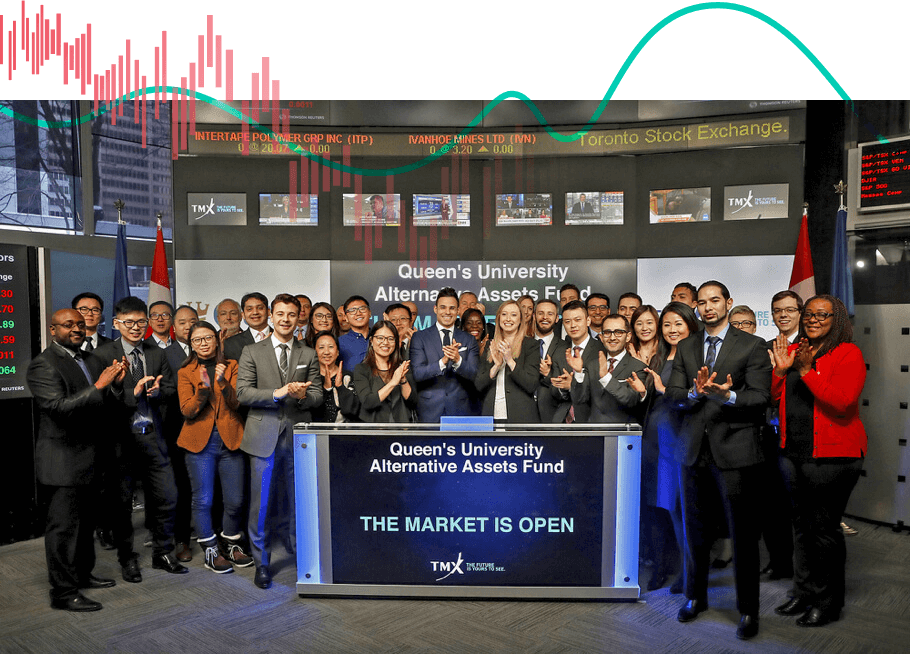
Queen's University Alternative Assets Fund
Students in the MMAI program have the opportunity to participate in the Queen’s University Alternative Assets Fund (QUAAF). It is the only student run hedge fund in North America and is comprised of an Executive Committee and teams of Analysts. They are supported by an Advisory Committee of industry professionals. This fund has been seeded with contributions from alumni and friends of Queen’s, and all proceeds contribute to the maintenance and expansion of the fund.
Learn more about QUAAF