What is Impact Analysis?
Every leader, organization, and government wants to do better, achieve more good, and create more impact. But impact isn’t one thing — and the tools to analyze it are scattered across disciplines that rarely talk to each other.
Everyone wants to
- Do better
- Achieve good
- Have more impact
Impact has many dimensions
While all these dimensions matter, the tools to analyze and document them remain fragmented across sectors, institutions, and disciplines.
A partial view of impact leads to poor decisions.
The Impact Analysis Toolkit
The foundation of CPIA is the Impact Analysis Toolkit. This toolkit is rooted in the understanding that good impact leadership is more than measurement and forecasting. It is about defining what matters, understanding relationships in data and evidence, respecting all worldviews, comparing trade-offs fairly, recognizing uncertainty, and communicating clearly enough to support wiser decisions and generate more credible impact reports.
The Impact Analysis Toolkit equips leaders to do that by giving them ten tools in three categories.
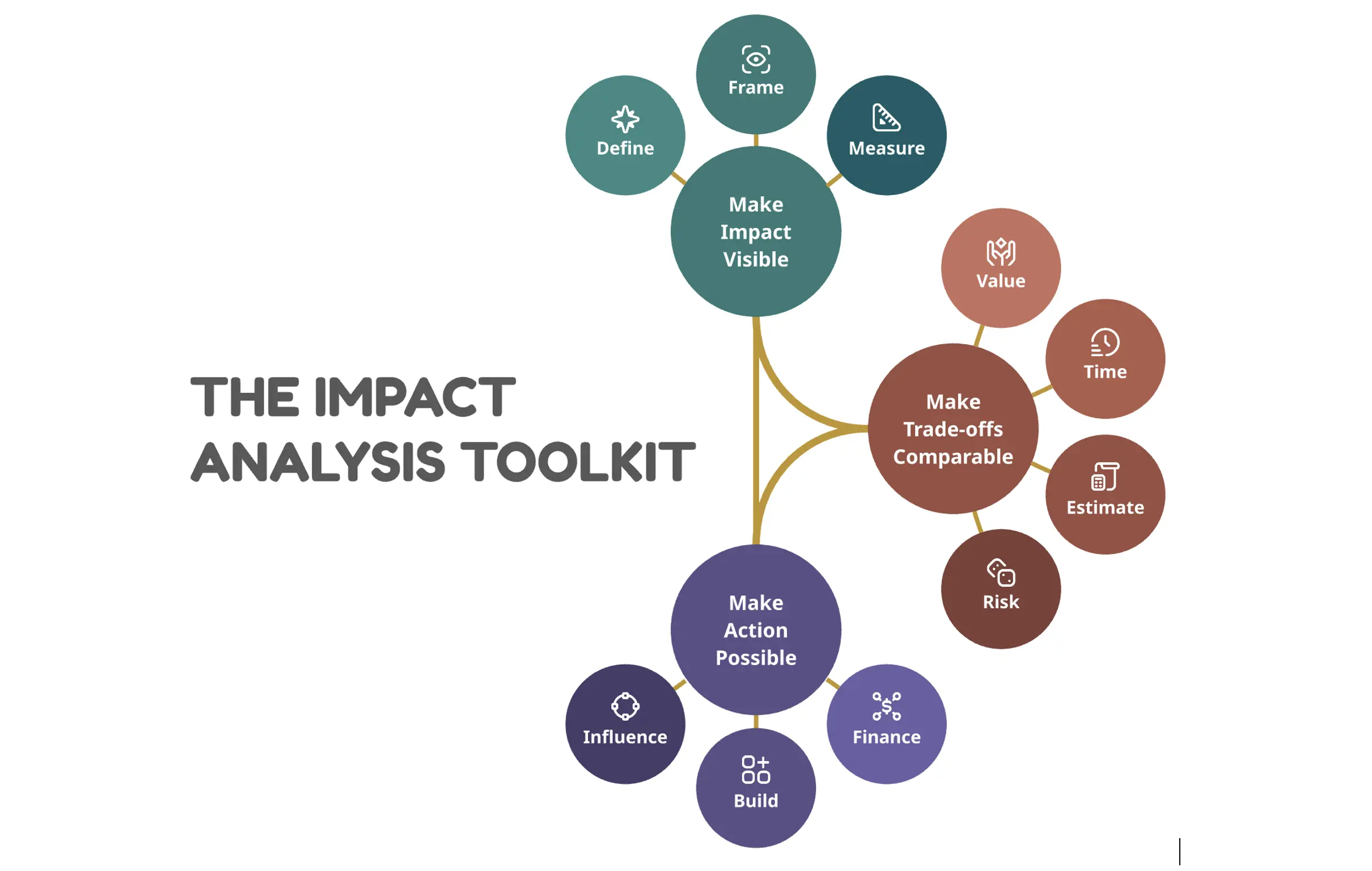
Make Impact Visible
Define
Identifying what matters.
The outcomes and units that make impact visible. Beyond numbers — naming the spirit of the impact so it can be honoured and tracked.
Frame
Harmonizing perspectives.
Integrating impacts into a decision-support framework that respects alternative worldviews.
Measure
Observing relationships in data.
Using data to observe change and move from correlation to understanding the cycles and ripples (causation).
Make Trade-offs Comparable
Value
Acknowledging value.
Translating measured impacts of different natures into comparable terms to quantify trade-offs.
Time
The view across the horizon.
Making impacts that occur at different times comparable, from years to decades to generations.
Estimate
Getting more out of data.
Using forecasting, transferring, and simulation techniques to estimate impacts that we cannot observe.
Risk
Embracing uncertainty.
Recognizing that life is non-linear. Learning techniques not to control the future, but to prepare for its many paths.
Make Action Possible
Finance
Directing energy.
Seeing capital, including innovative financing models, as a current that must be steered to where it can do the most good.
Build
Structuring the data.
Using spreadsheets to structure logic, run calculations, organize evidence, and make analysis transparent and usable.
Influence
Telling the story.
Translating the analysis into a narrative that breaks down barriers and moves people to collective action.
The Certificate in Professional Impact Analysis Approach
Our program is based on academic research and years of experience in diverse settings. Learn more about our faculty’s expertise.
The learning modules are designed so that individuals at any level of a business, NGO, foundation, international development entity, finance institution, or government will advance their knowledge of impact evaluation.
Those wishing to further their studies, advance their careers or develop skills in these fields will also benefit from the Certificate in Professional Impact Analysis modules and certification.
For organizations, training your employees or hiring those who have achieved the Certificate in Professional Impact Analysis designation will allow you to:
- Be confident your organization is on the cutting edge of rigorous impact analysis
- Offer enhanced accountability to stakeholders and transparency to the public
- Have better alignment in measurement, evaluation and financing across organizational units

Insights
Explore the latest on social impact from our faculty and industry experts.