
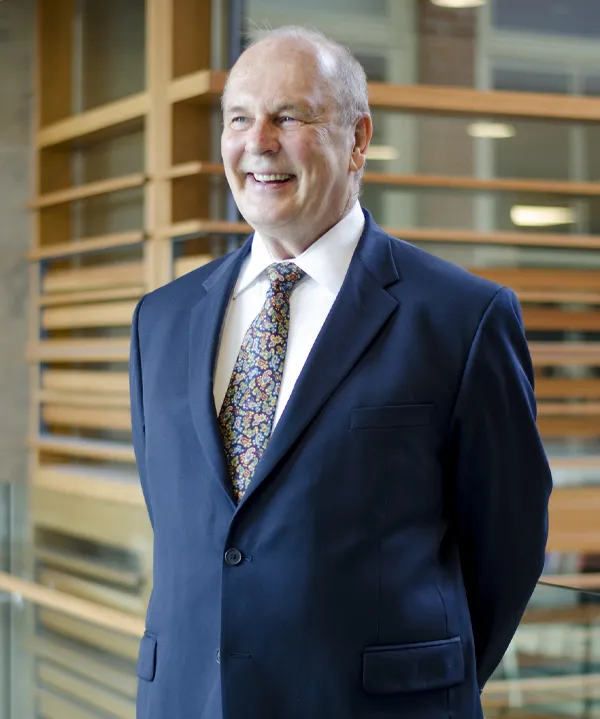
The legacy of Dr. Edwin (Ted) Neave at Smith School of Business was solidified decades before his death in 2023.
As an academic, Ted’s record was beyond reproach: He taught finance at the school for 34 years, publishing dozens of influential papers and books, supervising scores of graduate students, and developing teaching modules adopted by the Institute of Canadian Bankers and used in more 40 countries around the world. After his official retirement in 2005, he spent a decade as an active Emeritus professor, showing up to work almost every day to immerse himself in the colleagues and culture that gave him such fulfillment. In 2009, he was inducted in the Smith Faculty Hall of Fame.
“He was very giving of his time, whether he was working with students or junior colleagues,” recalls Dr. Lynnette Purda, Interim Dean, Professor, and RBC Fellow of Finance at Smith. Lynnette first met Ted when she joined the school in 2002, fresh off completing her PhD in finance. The pair quickly connected over their shared academic interests, and—as neighbours—fell into a habit of walking to work together and talking through research or teaching ideas en route. “He generously shared his expertise.”
Yet Ted gave much more than that. In 2019, he made an important decision: To name Smith as a beneficiary of his estate. On his passing nearly four years later, it became clear just how generous that choice was, amounting one of the largest donations for student awards in the school’s history. The result is a new Outreach Scholarship for Higher Education, which assists a promising Smith Commerce graduate planning to pursue advanced studies, ideally in a research-based Masters or PhD program.
It doesn’t surprise Lynnette that Ted chose to direct his gift towards the next generation of researchers. Her mentor was as pragmatic as he was bright: He knew that the right support could entice promising prospects who might never have otherwise considered an academic future. “The school was his passion, especially its graduate students,” she says. “This one gift allows us to both inspire students and make their studies more accessible. It’s incredibly powerful.”
Ted lived a version of this himself. Born and raised in Kyuquot, B.C., a remote outpost on the northwest coast of Vancouver Island, he was the first in his family to pursue higher education—an effort supported by the entire community. (He carried a small good luck token his neighbours gave him on his departure for the rest of his life.) After completing an undergraduate degree at the University of Victoria, he started a career at CIBC, where he quickly climbed the ranks before opting to leave the private sector for academia. “He could have easily made himself very successful in the high echelons of banking,” reflects his daughter, Barbara Quesnel, who today works at the School of Graduate Studies at Queen’s. “But that wasn’t where his heart was. He wanted to teach. He wanted to help other bright lights.”
Upon arriving in Kingston to start teaching at Smith in 1971, he established a reputation as a kind-but-demanding instructor and a relentless researcher. Barbara recalls growing up in a book-filled home where spirited conversations among her parents, her dad’s students, and faculty colleagues were the norm. “Whenever he would get a new grad student with promise, he’d get a light in his eye like nothing else,” she says. “He really lived, breathed and loved his life at Queen’s.”
Furthermore, Ted knew exactly how impactful a well-thought-out financial gift could be. In 2014, he created the Elizabeth Neave Fellowship to honour his late wife, which has, to date, helped fund the work of 16 MSc students pursuing cutting-edge research projects. (Current recipients are studying the application of data to predict serious heart events and the role of certification programs in shaping how businesses engage with social and environmental movements, among other things.) Barbara says it gave her father great satisfaction in his later years to see his wife’s passion for knowledge and innovation live on through the work of fellowship winners. “Both of my parents were adamant about the value of research,” she says. “So, they planned to pay it forward.”
Indeed, legacy gifts like these can leave a lasting mark, Lynnette says. “Dr. Neave created this gift out of a pure desire to help more students, and he did it with true humility,” she says, pointing out that news of the endowment only became public after his passing. “He was not someone who wanted a big fanfare when he was here. But now that he is gone, and his impact is so clear, it is on us to celebrate his legacy.”