
Leadership Evolved: From Hierarchy to Collaboration
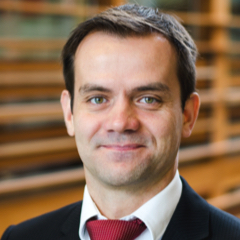
Matthias Spitzmuller
Associate Professor & Distinguished Professor of Organizational Behaviour
So my research focuses on two broad streams. The first one investigates helping behaviors in cooperative workplace behaviors. So it's the question of why do employees invest more into their work, into relationships with co-workers than they would have to? And how does it affect themselves, their co-workers, the teams, and the organizations that they are part of?
The second stream, and this is also where most of my work takes place right now, is in teams and team leadership. I'm trying to understand the question, how can leadership enable teams to bring out their very best, not only as they're working on their daily tasks, but also as are thinking about innovating, as they're thinking about going beyond the status quo.
When we're thinking about leadership, we're usually thinking about this one strong leader who has got the answer for the for the team, and the team members are basically just tools to execute that leader's vision. My own view of leadership is radically different from that. I view leadership as a collective process in which teams can collectively determine which direction to take, and where teams can collectively also experience the energy to break with their past and to do something radically different.
And so in my research projects, in different settings, some of them in the lab, some of them in the field, I investigate their collective sense making processes and activation processes that provide collective leadership for a team.
There's one particular study that I'm proud of, if I may say that. It is a study that was published about eight years ago and conducted with a wonderful co-author in Germany, Michael Gielnik, where we investigated entrepreneurial passion. And the reason why I think this project is really important is because it tells us a very different story about how entrepreneurship works, and also about how ventures are successful.
What we find in this research is that a passion that entrepreneurs have is oftentimes not present from day one. We tend to think that if entrepreneurs don't have this tremendous passion, their ventures are doomed to fail. But what we find is that the passion is oftentimes the result of very hard work that they put into their venture. So passion does not come first and then the hard work follows, but hard work comes first and seeing progress, and then passion is a consequence of that.
I think this is an important finding not only in the context of entrepreneurship, but also in our lives. What I see very often with our students—MBA students or commerce students—they have the expectation that they are passionate about a subject when they enter a program, and this passion should grow like a plant and ultimately lead them to a career where they never have the feeling that they need to do work that they don't like. It should all just flow naturally.
What our finding shows is that hard work creates that passion. So don't be too disappointed if you start a program, or in your position in life right now, if you don't experience that passion for something because it grows naturally as you invest yourself in a task, if you make it your own over time with the progress that you invest.
I think it's also an important lesson in the context of leadership, because it shows that over time as a team you can cultivate a sense of passion, a sense of togetherness, [that it’s] not necessarily something that has to be there right from day one.